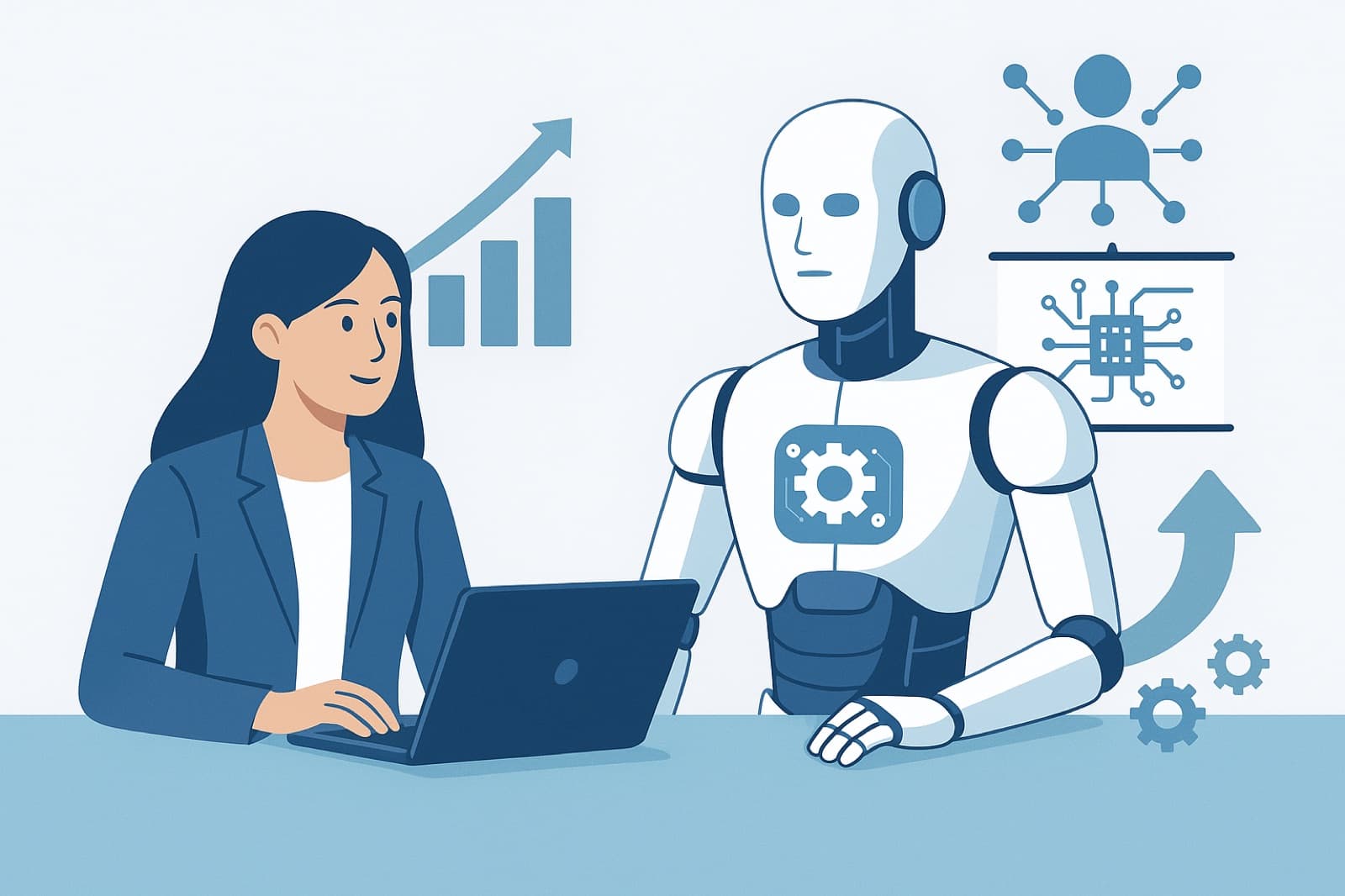
AI Workforce Integration for Business Transformation: A Practical Roadmap for Leaders
Introduction - What AI workforce integration means and why it matters
AI workforce integration for business transformation refers to the systematic adoption of artificial intelligence technologies into everyday workflows, the redesign of roles and processes, and the alignment of people, data, and governance to realize measurable operational improvements.
For business leaders and HR, this is not just a technology project - it's an organizational change program that affects productivity, talent, compliance, and culture. Early and thoughtful integration turns AI from a cost into a capability: faster decisions, fewer routine errors, and better allocation of human judgment to strategic work.
"Integrating AI into the workforce is about augmenting human potential, not replacing it."
How-to: Implementation checklist and recommended tools
Use this checklist as a practical start for AI workforce integration for business transformation. Treat each item as a milestone in a phased program rather than a single sprint task.
Implementation checklist
- Define clear business outcomes. Identify 2-4 priority use cases tied to revenue, cost, or risk reduction.
- Assess data readiness. Inventory data sources, quality gaps, and access controls needed for model training and inference.
- Map roles and processes. Document current workflows and where AI will touch decisions, approvals, and handoffs.
- Choose a pilot scope. Start with a constrained scope (one function or site) and measurable KPIs.
- Build cross-functional governance. Establish stakeholders from IT, operations, HR, legal, and compliance.
- Design upskilling and change management. Prepare learning paths and communication plans for affected employees.
- Measure and iterate. Track KPIs, collect qualitative feedback, and refine models and processes.
Recommended tool categories (examples of what to evaluate)
- Data platforms: Cloud data lakes, real-time integration, and MDM for a single source of truth.
- Model development & MLOps: Tools for model training, versioning, CI/CD for ML, and monitoring.
- Low-code/Automation: RPA and low-code platforms for rapid workflow automation and citizen development.
- Employee-facing AI: Conversational AI, decision support dashboards, and knowledge-base augmentation tools.
- Governance & security: Workflow auditing, explainability libraries, and role-based access controls.
Choose vendors that support integration with existing systems, have transparent model behavior, and provide enterprise-grade security and audit trails.
Five-step practical roadmap: concrete strategies with roles and metrics
Below are five concrete, sequential strategies to implement AI workforce integration for business transformation. Each step includes recommended actions, primary stakeholder roles, and success metrics.
Step 1 - Identify high-impact use cases
Actions:
- Run a workshop to list pain points, quantify impacts, and prioritize by feasibility and value.
- Create a business-case template that estimates ROI, timeline, and change risk.
Stakeholder roles:
- Business owners: define outcomes and sign off on priorities.
- Data/Analytics team: validate data availability.
- Finance: model ROI and cost baselines.
Success metrics:
- Number of validated use cases with business sponsor and ROI estimate.
- Projected vs. baseline cost or time savings per use case.
Step 2 - Pilot, evaluate, and secure quick wins
Actions:
- Deploy a narrow pilot with defined inputs and outputs.
- Collect quantitative results and qualitative user feedback over 6-12 weeks.
Stakeholder roles:
- Project manager: coordinate sprint cadence.
- Operations lead: ensure pilot environment mirrors production constraints.
- HR/L&D: track employee acceptance and learning needs.
Success metrics:
- Pilot KPI attainment (e.g., time saved, error reduction).
- User adoption and satisfaction scores.
Step 3 - Scale with repeatable processes and MLOps
Actions:
- Standardize data ingestion, model deployment, and monitoring pipelines.
- Create a catalog of reusable components and templates for new use cases.
Stakeholder roles:
- IT & MLOps: build deployment and monitoring frameworks.
- Security/Compliance: embed controls into pipelines.
- Business units: identify scaling priorities.
Success metrics:
- Time to production for new models (reduction in weeks/days).
- Number of models in production with SLAs and alerts.
Step 4 - Reconfigure roles & upskill the workforce
Actions:
- Redesign job descriptions to reflect augmented responsibilities.
- Launch targeted training and micro-credential programs.
Stakeholder roles:
- HR: lead role redesign, career pathways, and performance metrics.
- Managers: coach employees and allocate time for learning.
Success metrics:
- Percentage of affected employees trained and certified.
- Improvement in role efficiency and employee engagement scores.
Step 5 - Govern, measure, and sustain continuous improvement
Actions:
- Establish governance policies for model risk, explainability, and data privacy.
- Implement continuous monitoring for model drift and business impacts.
Stakeholder roles:
- Governance council (IT, Legal, Compliance, Business): review incidents and approve changes.
- Analytics: maintain dashboards tracking KPIs and model health.
Success metrics:
- Number of governance incidents resolved within SLA.
- Consistent sustained KPI improvements across quarters.
Review: Three detailed case studies of successful AI workforce integration
These anonymized case studies demonstrate how AI workforce integration for business transformation can deliver measurable value in different contexts.
Case Study A - Manufacturing: Predictive maintenance that shifted work from firefighting to planned interventions
Objective: Reduce unplanned downtime on critical production lines.
Implementation approach: Sensors fed historical and real-time telemetry to a predictive model. A cross-functional pilot team included maintenance leads, data scientists, and plant operators. Alerts were delivered to operators via a mobile dashboard tied to work-order systems.
Measurable outcomes: Unplanned downtime dropped substantially within six months, planned maintenance increased, spare-parts inventories optimized, and overall equipment effectiveness (OEE) rose measurably.
Lessons learned: Involving floor operators early improved alert relevance; coupling alerts with existing work-order workflows maximized adoption.
Case Study B - Financial services: AI-assisted underwriting to speed decisions and reduce risk
Objective: Shorten loan decision times and standardize risk assessments.
Implementation approach: A hybrid model combined rule-based scoring with ML risk signals. Underwriters used AI-driven summaries and confidence scores to make final decisions. HR redesigned training for underwriters to interpret model outputs and escalate edge cases.
Measurable outcomes: Decision time reduced by a significant margin, default rates remained stable or improved, and employee throughput per underwriter increased.
Lessons learned: Transparency in model rationale and clear escalation paths maintained trust and compliance.
Case Study C - Professional services: Knowledge augmentation to boost consultant productivity
Objective: Reduce time spent on research and draft creation, allowing consultants to focus on advisory work.
Implementation approach: Integrated a knowledge-augmentation assistant into document workflows. The assistant suggested templates, auto-summarized prior engagements, and surfaced precedent clauses.
Measurable outcomes: Proposal turnaround time shortened, billable utilization increased, and client satisfaction improved due to faster delivery.
Lessons learned: Tight integration with document management and version control prevented rework and ensured content compliance.
Five key impacts of AI workforce integration and practical considerations
Below are five concise impact areas organizations will encounter when pursuing AI workforce integration for business transformation, with short mitigation and governance notes.
-
Productivity gains:
Automation of repetitive tasks frees time for higher-value work. Early adopters regularly report measurable time savings and throughput increases.
-
Role changes and new job families:
Expect shifts toward AI-fluent roles: model operators, data stewards, and AI ethicists. Clear career pathways reduce anxiety and turnover.
-
Common challenges:
Data quality, change resistance, and unclear governance are common blockers. Underestimating integration complexity can stall programs.
-
Mitigation tactics:
Invest in data foundations, phased pilots, transparent communication, and fast feedback loops. Pair technical pilots with parallel human-centered design work.
-
Governance and ethics considerations:
Define policies for fairness, explainability, and privacy up front. Use audits, model cards, and human-in-the-loop checks for higher-risk decisions.
Forward-looking perspective: The future of employment, required skills, and recommendations for leaders
AI workforce integration for business transformation will reshape job content more than eliminate entire professions in the near term. Routine tasks are most exposed; roles emphasizing complex judgment, empathy, and strategic thinking will grow in importance.
Leaders should prepare by investing in three skill clusters:
- AI literacy: Basic understanding of AI capabilities, limitations, and risks for managers and domain experts.
- Data skills: Data stewardship, interpretation of analytics, and ability to work with automated insights.
- Human-centric skills: Problem framing, complex decision-making, change leadership, and cross-functional collaboration.
Recommendations for leaders:
- Start with high-value pilots but plan for scale from the outset.
- Align HR, operations, and IT on a joint integration roadmap.
- Make governance proportional: heavier controls for high-risk decisions, lighter for internal productivity aids.
- Track both quantitative KPIs and qualitative employee sentiment to ensure sustainable adoption.
Conclusion
AI workforce integration for business transformation is a strategic journey that blends technology, people, and governance. By following a deliberate checklist, piloting with measurable KPIs, scaling through repeatable processes, and investing in workforce transitions, organizations can unlock efficiency and innovation while managing risk.
Consider piloting an AI workforce integration plan tailored to your organization's highest-value use case and build from measurable wins.