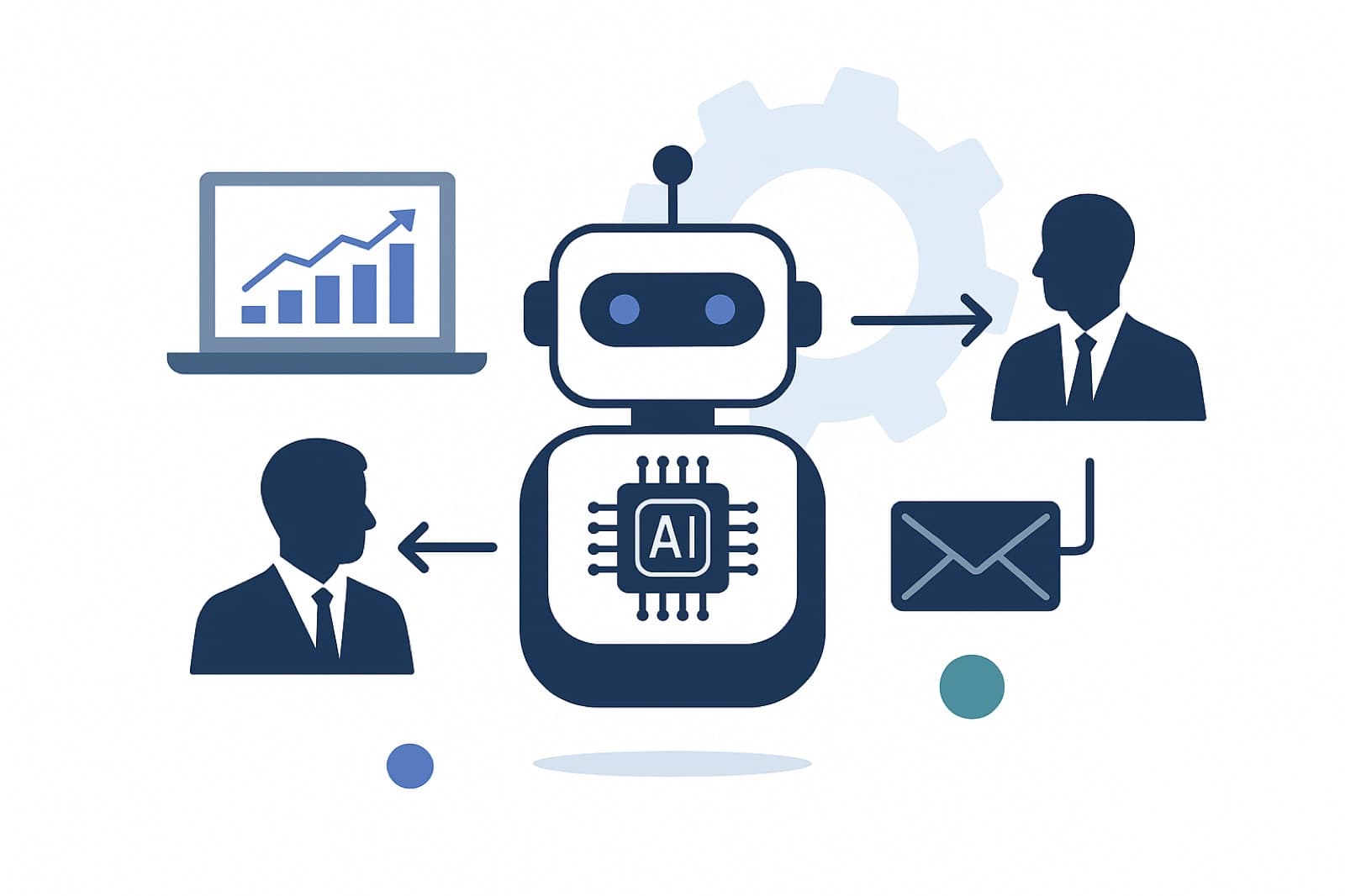
AI automation for B2B outbound means using models to research prospects, draft personalised openers, sort replies and log activity to your CRM, while people decide what gets sent. The AI part is now easy to buy. The part that decides whether it works sits underneath it. Gmail, Yahoo and Outlook junk or reject mail from senders who skip authentication or draw complaints, and B2B email carries the same legal duties as consumer email. Build the send gates first, then add AI.
This guide covers the mechanics of running AI-assisted outbound safely. If you are still deciding whether outbound is the right place to start, read our case for automating inbound capture before net-new prospecting first. This article was drafted with AI assistance, then edited and fact-checked by our team. Every provider and legal rule below was checked against the provider's or regulator's own page on 30 September 2026.
What does AI automation for B2B businesses look like in outbound?
Outbound is six separate jobs. AI can own three of them, should only draft a fourth, and has no role in the last two. The split we use when we scope an outbound build:
| Outbound job | What AI does well | Our default |
|---|---|---|
| Account and contact research | Reads a company's site, job posts and news and writes a short brief a rep would otherwise assemble by hand | Automate, and spot-check a sample of briefs every week |
| Opening line and personalisation | Drafts an opener from the brief, inside a template a person wrote | Draft only. A person approves the template and reads the early batches |
| Sequencing and send timing | Nothing. This is rules work: who gets what, when, and how many per day | Deterministic automation with hard caps |
| Reply triage | Sorts replies into interested, not now, out of office, wrong person and opt-out | Automate, but every possible opt-out goes to suppression without waiting for review |
| CRM logging | Writes the activity, the reply summary and the next step to the record | Automate |
| Discovery calls, pricing, negotiation | Call notes and preparation briefs at most | Keep human |
AI handles the reading and the first draft. Rules handle anything that touches volume, timing or consent, because those steps carry legal and reputational consequences and a model's output is not predictable enough to own them.
What do Gmail, Yahoo and Outlook require before you scale AI outbound?
All three large mailbox providers publish sender rules. They are the floor any AI outbound system has to clear, and the reason volume is the dangerous variable. Summarised from each provider's own page:
| Rule | Gmail (personal accounts) | Yahoo | Outlook.com, Hotmail, Live |
|---|---|---|---|
| Who it covers | All senders to @gmail.com and @googlemail.com, with stricter rules above 5,000 messages a day | All senders, with stricter rules for bulk senders | Domains sending 5,000 or more messages a day to Microsoft's consumer mail |
| Authentication | SPF or DKIM for everyone. SPF, DKIM and DMARC for bulk senders, with the From domain aligned | SPF or DKIM for everyone. SPF, DKIM and a DMARC policy of at least p=none for bulk senders | SPF, DKIM and DMARC of at least p=none, aligned with SPF or DKIM |
| Spam complaints | Below 0.3%. Google recommends staying under 0.10% in Postmaster Tools | Below 0.3% | No threshold published on the announcement |
| Unsubscribe | One-click unsubscribe for marketing mail from bulk senders, plus a visible link in the body | One-click unsubscribe for bulk marketing mail, honoured within 2 days | A clearly visible opt-out is listed as a best practice |
| Enforcement | Since 1 February 2024 | In force | Non-compliant mail routed to Junk from 5 May 2025. Rejected mail returns error 550 5.7.515 |
Sources: Google's email sender guidelines, Yahoo Sender Hub best practices, Microsoft's announcement for high-volume Outlook senders.
Two things matter for B2B teams. First, these rules are written for consumer mailboxes. Many B2B prospects read mail on company domains hosted on Google Workspace or Microsoft 365, behind filters that publish no thresholds, so treat the table as the minimum. Second, the 0.3% ceiling is three complaints per 1,000 messages. When an AI drafts the emails, the cost of one more send falls to almost nothing, and send volume can grow faster than list quality. That is how teams cross the line without noticing.
What does the law require of automated B2B cold email?
Automation changes none of the legal duties, and handing sending to a vendor's AI agent does not move them either.
United States. The FTC's CAN-SPAM guide is direct on the point: "The law makes no exception for business-to-business email." Each commercial message needs accurate header information, a subject line that reflects the content, a clear statement that it is an advertisement, your valid physical postal address and a clear way to opt out. Opt-outs must be honoured within 10 business days. The FTC also says you cannot contract away responsibility when another company sends for you, and each violating email can draw a penalty of up to $53,088 (FTC compliance guide).
European Union. GDPR Recital 47 says processing personal data for direct marketing "may be regarded as carried out for a legitimate interest", which makes B2B prospecting possible without prior consent in many cases, subject to a balancing test. Article 21 gives every recipient the right to object at any time, and once they do, their data can no longer be processed for marketing. Separately, each member state's ePrivacy rules decide whether cold email to a named person at a company needs consent, and those rules differ by country. Check the recipient's country, not yours. This summary is not legal advice.
For an AI system the practical rule follows directly: the model never decides whether an opt-out counts. A reply that could be an opt-out goes to the suppression list by rule, and a person can reverse it later if the classifier was wrong. Missing a real opt-out is the costlier error, because every later email to that person risks a complaint and, after 10 business days, breaks CAN-SPAM.
Which AI-powered outbound solutions fit a B2B sales team?
The products fall into three shapes. Pick the shape before you compare vendors.
| Shape | Good at | Watch for | Fits |
|---|---|---|---|
| AI features inside the sequencer or CRM you already use | Lowest setup effort. Data and sending stay where they are | You get the features the vendor ships. Caps and suppression rules are still yours to configure | Teams already running outbound with a clean CRM |
| A standalone AI SDR agent | Research, drafting and sending in one product | It sends from your domain, and the legal duty stays with you. Check exactly what it can send without approval, and how it handles an opt-out reply | Teams testing whether outbound works for a new segment |
| A custom workflow on your own stack | Every gate is yours: approvals, caps, suppression, logging, and the research sources the model may use | Needs an owner after launch. Tuning and exceptions are ongoing work | Teams with compliance requirements, an unusual ICP or several systems to connect |
We build the third shape, so weigh our view accordingly. For many teams the first shape is enough. The third earns its cost when outbound has to follow rules that a packaged tool cannot express, such as per-country consent logic or approvals that depend on account value. Our AI automation services page describes how those builds are scoped.
What guardrails do we run on our own outbound email?
ATI sends its own outreach, mostly pitches to writers and editors who have covered topics we hold original data on. It runs through a small script built on the gates above. Claude researches each recipient and fills the personal fields. The script decides whether anything leaves.
- It has no free-text mode. It can only send a template a person has approved.
- For personalised templates, it refuses to send the whole batch if any recipient is missing a required field. A blank field stops the run instead of producing "Hi {name}".
- A dry-run prints every message in full before anything is sent.
- Every send is written to a log with the time, recipient, subject, template and message ID.
The output is small on purpose. Between 14 August and 24 September 2026 it sent 23 messages. For a sales team the numbers would be larger, but the design point holds: volume is set by a rule a person wrote, never by how fast the model can draft.
How should you measure AI outbound?
Measure the constraints first and the results second. Emails sent and leads created rise the moment the system switches on, so they prove nothing on their own.
- Spam rate in Google Postmaster Tools, checked weekly, against the 0.10% Google recommends.
- Bounce rate per list source, which tells you which research or data source is going stale.
- Time from an opt-out reply to suppression. It should be minutes, well inside Yahoo's 2 days and CAN-SPAM's 10 business days.
- Positive replies per template, reviewed by a person, since a classifier's "interested" label is itself a model output.
- Meetings held and opportunities created, which lag by your sales cycle.
Our pipeline generation guide covers the downstream metrics that automation cannot inflate. If your team is small and still choosing where AI goes first, start with our guide to the first workflows to automate in a small business.
Frequently asked questions
Is AI-written cold email legal for B2B?
Yes in the US, and in many cases in the EU, provided the email itself meets the rules. In the US, CAN-SPAM applies to B2B email with no exception and requires an honest subject line, a postal address and an opt-out honoured within 10 business days. In the EU, GDPR allows direct marketing on legitimate interest in many cases, but national ePrivacy rules vary and every recipient can object at any time. Who or what wrote the email does not change these duties.
Do the Gmail bulk sender rules apply to B2B email?
Google's rules cover mail sent to personal Gmail addresses. Prospects on Google Workspace or Microsoft 365 sit behind their company's own filtering, which is not published. Those filters are not documented publicly, so meeting the consumer rules is the practical minimum for B2B senders too.
How many cold emails can an AI tool send per day?
The 5,000-a-day figure in Google's and Microsoft's rules is the point where stricter authentication applies. It is not a safe quota. The right cap is the volume your list quality and complaint rate can support, written down as a rule a person owns.
Should AI send outbound emails without human review?
Not at the start. Have a person approve every template and read the early batches in full. Once a template has held quality for several weeks, reviewing a sample is reasonable. Opt-out handling and send caps should never depend on review. They belong to rules that run every time.
What are the best AI-powered outbound solutions for B2B sales?
There is no single best tool, because the options differ in shape. AI features inside your existing sequencer suit teams with clean data. Standalone AI SDR agents suit fast tests of a new segment. Custom workflows suit teams with compliance rules or several systems to connect. Choose the shape first, then compare vendors inside it.